C "Commando" platoon, 9 Borders Potsangbam, near Imphal 7 May 1944

History
Imphal was a road junction and a vital supply dump for the Allied forces of 14th Army In India. It stands close to the Burmese border and the passes through the jungle cover Chin Hills that mark that rugged border. General Mutaguchi commanding the Imperial Japanese Army in Burma ordered the attack with troops of the 33rd, 31st and 15th Division along with substantial support from the Indian National Army and they crossed the Chindwin River on 8th of March to cross the hills on foot. General Scoones commanding IV Corp was aware of the attack but not its scale or the timing He therefore concentrated his forces toward Imphal. Whilst General Slim of 14th Army flew in troops including the 17th Diviison and M3 tanks of the 3 Carabiner (Prince of Wales Dragoon Guards)
The Battle of Bishenpur is the name given to the fighting that took place on or near the Tiddim Road south of Imphal between early April and early May and as such is one part of the much larger battle of Imphal. The Japanese 33rd Division came up against the last British defences south of Imphal. The Tiddim Road ran almost straight across the open paddy fields of the Imphal plain. Along the length of the road lay the villages to one side or the other. Colonel Taguchi, commander of the Engineer Regiment, would take his own 4th Independent Engineer Regiment, 2/213 Battalion (less two companies), and an anti-tank detachment up the road to Bishenpur. They seized Potsangbam driving out British Indian Army patrols on the night of May and heavily fortifying the village. The 9th Borderers arrived with 48 brigade of 17th "Black Cat" Davison soon after and began to probe the village. Unaware of the true strength on the Japanese or the degree to which they had dug in early patrols where repulsed. This is one such action.
"I was given the order to advance with the platoon of 22 men along a wide track, with a monsoon ditch on either side, then jungle.
We had not got far when a mortar bomb (from our own mortars) fell behind us with disastrous results.
I regrouped with 17 men. We continued the advance with a bunker well hidden by the enemy.
I was ordered to withdraw and let a tank to go forward. This attack failed, the tank could not depress his gun low enough to hit the target."
from:
https://www.bbc.co.uk/history/ww2peopleswar/stories/16/a2422216.shtml
and
more details of the first battle of Bishenapur can be found at https://www.worldhistory.biz/sundries/15832-chapter-nine.html

Terrain
The road is a muddy track and does not give any movement benefits. The Jungle scrub limits line of sight to 30" and the Thick Jungle of banana limits the line of sight to 20". The monsoon ditches lie on either side of the road and allow infantry full movement but are impassable to vehicles and it soft cover. The paddy field beyond the jungle around the village are dried out at this time. The bunds around the field provide hard cover, The jungle and jungle scrub is soft cover. The foxhole and bunkers and spider holes provide reinforced cover for their occupants.Forces
British Indian Army
from 17th Black Cat Division
"C" Commando platoon, 9 Border Regiment (understrength) -
Platoon HQ 3 men Officer, Mortar Spotter
I "Tiger" recon patrol 3 men (scouts)
2 sections each of 6 men (regular)
1 LMG section 6 men with 3 Bren LMG
1 2" mortar section 2 men
1 Sniper (scout)
1 Anti Tank team 2 men with Boyes Anti Tank rifle
support 2 3" mortars (off table)
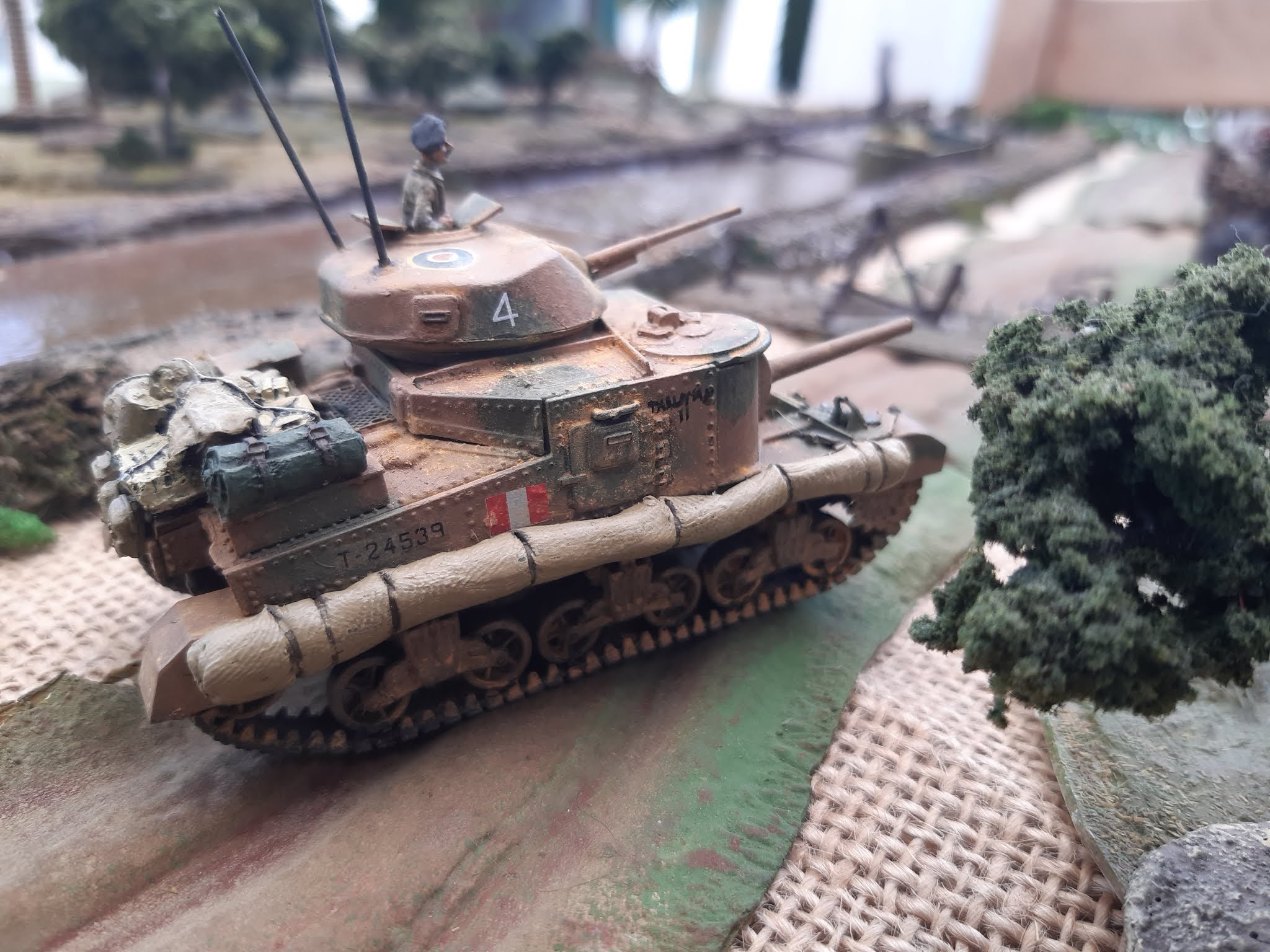
3 Carabiner (Prince of Wales Own)
1 M3 Grant Tank
from Imperial Japanese Army 33rd Division
2 squads from 213 Regiments
each consists of
Deployment
The British deploy 1d6 units into the deployment zone in the corner of the table deployment zone. The Japanese player then deploys all troops and defences. The Japanese player may keep 1d6 unit as an off table reserve. The remainder of the British force arrives in there deployment zone after turn 3.
Victory
The objectives are the bunker, There are two other objectives which may be places one by each side in the Japanese deployment zone. The Japanese cannot win an all objectives claimed victory
Map

AAR
 |
| British Force Commando platoon and supporting M3 tank from 3rd Carabiners |
 |
| Infantry of the defenders 2 infantry squads from 213 Regiment |
 |
| Each Infantry section has a Rifle element, an LMG element and an Antitank element with pole mine |
 |
| Japanese sniper in spider hole - well concealed and with overhead cover he is hard to spot and hard to hit. |
 |
| Japanese deploy there defences foxholes for the two LMG sections each supported by a spider hole with and LMG and a grenade launcher |
 |
The Heavy Machinegun bunker covers the road supported from either side by the infantry dug in and well concealed . |
 |
| The second set of foxholes cover the far side of the road |
 |
| The LMG in a spiderhole covers the flank |
 |
| The Commando platoon deploy all there Bren guns as a base of fire using the bund of the paddy as hard cover. |
 |
| The HQ deploy into the jungle scrubs with the Medical Orderly in support. |
 |
| The British 50mm mortar deploys in the jungle scrub beyond the road. It will cover the advance right flank |
 |
| Commando platoons "Tiger" scout deploy in the monsoon ditch with a line of site to the bunker |
 |
| The Bren section are supported by an understrength rifle section beside the paddy field bund. The Japanese LMG opens fire from the spider hole pinning the Brens. (indicated by the casualty marker. |
 |
| The second rifle section use the Monsoon ditch to advance. The M3 has advances under mortar fire an extremely fortunate hit from a British mortar pins the bunker but the tank is unable to spot the bunker with its 75mm. |
 |
The M3 struggled to spot the bunker as it was not firing!  |

 |
| Japanese infantry move through the jungle to support the advancing reserve of the two antitank teams |
 |
| Mortar fire bracket the bunker again. |
 |
| The suicide antitank teams creep closer to the tank along the edge of the jungle |
 |
Japanese rifle section pinned in the monsoon ditch by mortar fire  |
 |
| The infantry close with the Japanese defences. |
 |
| The Japanese force are starting to get pinned all over the table. The Japanese are reluctant to draw another Battle Rating counter. |

 |
| Nikeki team pinned! |
 |
| The British got liucky with there BR counter pulls although no plane turns up and the Japanese didn't have any artillery but they kept the total low. |
 |
| The Japanese series of unlucky chit pulls broke them in the end! |


